What Defines a High-Quality Wooden Door for Modern Homes?


A wooden door does much more than separate one room from another. It contributes to the first impression of a home, supports privacy and security, and can become an important part of the overall interior or exterior design. In modern homes, where homeowners often balance aesthetics with practicality, choosing the right wooden door requires more thought than simply selecting an attractive pattern.
Homeowners researching door manufacturers in Bangalore should therefore consider the quality of the timber, construction method, finishing, precision, stability and suitability of the door for its intended location. A well-manufactured wooden door can continue looking impressive for years, while a poorly selected option may develop alignment, finishing or stability problems much sooner.
What Does “High-Quality” Actually Mean for a Wooden Door?
A high-quality wooden door is not defined by appearance alone. Beautiful carving or an attractive surface finish may catch attention, but long-term quality depends on what is underneath the visible surface.
A good wooden door should combine several characteristics:
- Suitable and carefully selected timber
- Proper wood seasoning and treatment
- Accurate dimensions and construction
- Strong joints
- Smooth and consistent finishing
- Appropriate thickness for its application
- Reliable hardware compatibility
- Balanced design and proportions
- Resistance to normal environmental changes
- Quality workmanship throughout the manufacturing process
For homeowners, architects and builders, examining these factors before buying can make it easier to distinguish a genuinely well-made door from one that simply looks impressive in a showroom.
1. Start With the Quality of the Wood
The quality of a wooden door begins with the raw material.
Different types and grades of timber vary in appearance, grain structure, strength and long-term performance. Premium woods such as teak are commonly chosen for main entrances and feature doors because they can provide a distinctive natural appearance together with good durability when properly processed.
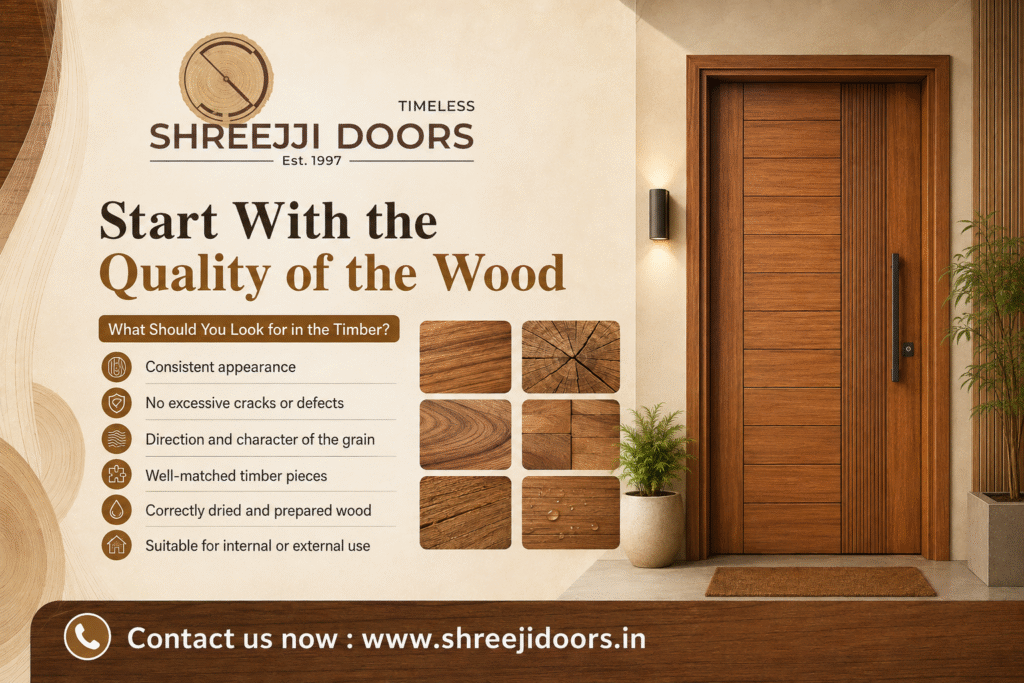
What Should You Look for in the Timber?
When examining a door, consider:
- Whether the wood has a consistent appearance
- Whether there are excessive cracks or visible defects
- The direction and character of the grain
- How well different pieces of timber have been matched
- Whether the timber has been correctly dried and prepared
- Whether the wood suits an internal or external application
Natural variation is part of the appeal of real wood. The objective is not necessarily to find timber where every section looks identical, but rather to choose a door where the natural characteristics have been used thoughtfully.
2. Proper Wood Seasoning Is Essential
One of the less visible but extremely important stages of wooden door production is seasoning.
Fresh timber naturally contains moisture. If too much moisture remains when the wood is manufactured into a door, dimensional movement can become more noticeable as environmental conditions change.
Proper seasoning helps bring the timber into a more suitable condition before manufacturing.
This can contribute to:
- Better dimensional stability
- More accurate joints
- Improved finishing
- Reduced risk of excessive movement
- More predictable long-term performance
This is one reason buyers should look beyond surface appearance and ask how the wood has been prepared before production.
3. Precision Manufacturing Makes a Major Difference
Modern wooden door manufacturing can combine traditional woodworking knowledge with advanced machinery.
Computer Numerical Control, commonly known as CNC, allows manufacturers to perform detailed and repeatable cutting operations with a high level of accuracy. CNC technology can be particularly valuable for doors featuring patterns, grooves, geometric details or intricate carving.
Precision matters because a door must work as a functional component, not simply as decorative furniture.
Correct manufacturing helps achieve:
- Consistent dimensions
- Accurate edges
- Cleaner detailing
- Better joint alignment
- Uniform design patterns
- Improved overall finishing
When comparing different wooden door manufacturers, buyers should therefore consider not only the door designs available but also the manufacturing technology and production processes behind those designs.
4. Examine the Construction and Joint Quality
The strength of a wooden door depends heavily on how its different components are assembled.
Poorly fitted joints can affect stability, alignment and appearance. High-quality manufacturing should create connections that are accurate and appropriately designed for the structure of the door.
When inspecting a sample door, pay attention to areas where rails, stiles, panels or decorative components meet.
Signs of Better Construction Include:
- Tight and consistent joints
- Straight edges
- Accurate corners
- Even panel positioning
- No obvious gaps between components
- Balanced proportions
- Consistent workmanship across the entire door
These details may appear small individually, but together they can reveal a great deal about manufacturing quality.
5. A Good Finish Should Enhance the Wood
Finishing has both an aesthetic and practical role.
The finish should complement the natural grain rather than disguise poor workmanship underneath. Depending on the design, homeowners may prefer a natural appearance, a deeper traditional tone or a clean contemporary finish.
A professionally finished door should generally feel smooth and consistent.
Check for:
- Uneven surface preparation
- Rough edges
- Visible sanding marks
- Inconsistent staining
- Poorly finished corners
- Unwanted gaps around carved areas
For natural timber doors, the beauty often lies in allowing the grain, texture and color variation of the wood to remain part of the design.
6. Choose a Door According to Its Location
Not every wooden door in a home has the same job.
A main entrance door may need to create a strong architectural statement while supporting security and regular daily use. An internal bedroom door may priorities privacy and consistency with the interior design. A Pooja room door may focus more heavily on traditional detailing and craftsmanship.
Main Entrance Doors
For a main door, consider:
- Strong construction
- Appropriate timber
- Security hardware compatibility
- Visual impact
- Exterior suitability
- Proportion relative to the entrance
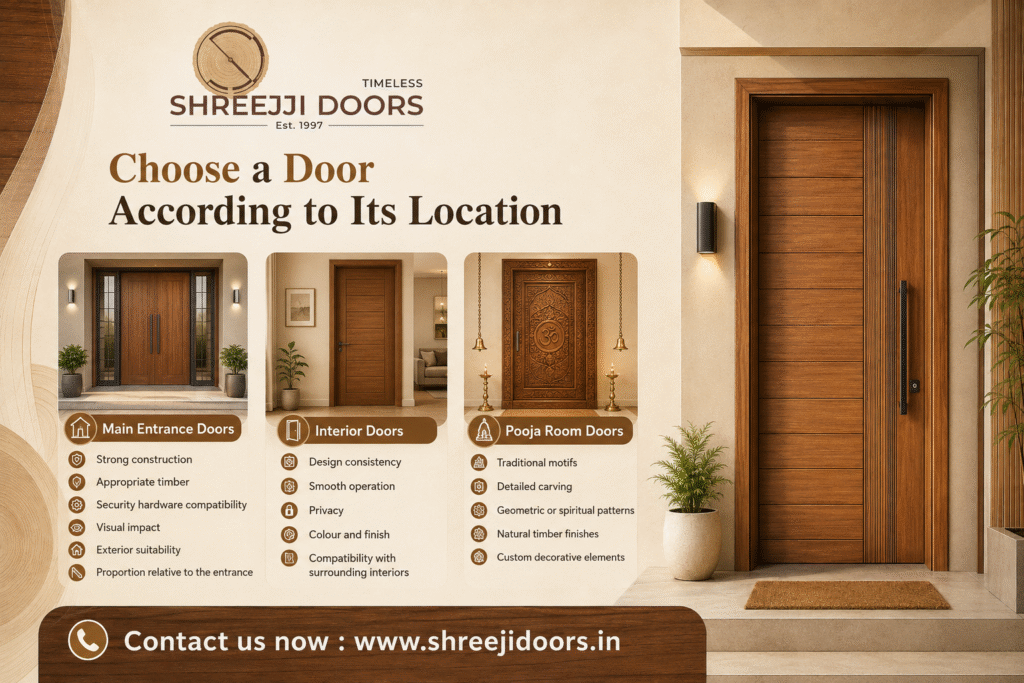 Interior Doors
Interior doors can focus more on:
- Design consistency
- Smooth operation
- Privacy
- Color and finish
- Compatibility with surrounding furniture and interiors
Pooja Room Doors
Pooja doors often become decorative focal points and may incorporate:
- Traditional motifs
- Detailed carving
- Geometric or spiritual patterns
- Natural timber finishes
- Custom decorative elements
Selecting according to the actual application is more effective than trying to use one door specification throughout the entire property.
7. Design Should Complement Modern Architecture
A high-quality door should feel like it belongs in the property.
Modern homes vary significantly in architectural style. Some feature minimal interiors with neutral colors and clean lines, while others combine contemporary planning with traditional Indian design elements.
Because of this, there is no single wooden door design that works for every modern home.
Popular Design Directions Include:
Contemporary Doors
Contemporary designs generally use cleaner lines, controlled detailing and balanced proportions. They can work particularly well with modern villas, apartments and minimalist interiors.
Natural Wood Designs
Natural-style doors place greater emphasis on grain, warmth and timber texture. They suit interiors where homeowners want wood itself to become a design feature.
Carved Doors
Carved wooden doors can add depth and craftsmanship to entrances, traditional interiors and premium residential projects.
Bold or Exotic Designs
For homeowners who want the door to act as a focal point, stronger textures, unusual patterns and distinctive detailing can create greater visual impact.
The best option should complement the flooring, wall finishes, furniture, lighting and overall architectural language of the home.
8. Consider Door Hardware Early
A premium wooden door can lose much of its practicality if the hardware is treated as an afterthought.
Handles, hinges, locks and other accessories should suit the size, weight and function of the door.
Before finalizing a door, discuss:
- Hinge requirements
- Lock configuration
- Handle positioning
- Digital lock compatibility if required
- Door closer requirements
- Other security hardware
- Opening direction
Planning these elements during the door selection process can reduce the need for unnecessary modifications later.
9. Customization Can Improve the Final Result
Standard-sized doors can work well for many projects, but some homes have entrances or architectural requirements that benefit from greater flexibility.
Customization may involve:
- Door dimensions
- Carving patterns
- Surface detailing
- Style selection
- Timber appearance
- Finish
- Hardware preparation
Architects and homeowners planning a distinctive entrance should discuss customization early because the door may need to coordinate with wall openings, frames, flooring and other construction details.
10. Ask About the Manufacturing Process
A buyer does not need to become a woodworking expert, but asking a few questions can reveal how seriously a manufacturer approaches quality.
Useful questions include:
- What timber is being used?
- How is the wood seasoned?
- What manufacturing technology is used?
- How are dimensions controlled?
- What quality checks are performed?
- What designs are available?
- Can the door be customized?
- What preparation is required before installation?
- What maintenance will the door require?
A manufacturer that can clearly explain its materials and processes gives buyers more information to make a considered decision.
Why Choose Shreeji Doors?
Shreeji Doors combines traditional wooden-door craftsmanship with modern manufacturing technology. The company states that it has more than 27 years of experience and uses a 4-axis German CNC machine for accuracy and finishing, together with wood treatment and automatic seasoning facilities designed to improve timber stability and joint accuracy. Its range includes Natural Solid Teak Doors, carved Classic doors, Contemporary Doors, Exotic Doors and Pooja Doors, with a warehouse in Bangalore serving residential, commercial and architectural requirements.
For homeowners, architects and builders comparing wood door manufacturers, these capabilities make Shreeji Doors worth considering when the project requires a combination of design choice, timber craftsmanship, production accuracy and modern manufacturing processes.
Final Thoughts
A high-quality wooden door is the result of many details working together. Timber selection matters, but so do seasoning, construction accuracy, joint quality, finishing, hardware planning and suitability for the location where the door will be installed.
Rather than choosing a door based only on its appearance, homeowners should consider how it has been manufactured and how well it fits the architectural requirements of their property. The right wooden door should look impressive when installed while also providing the strength, functionality and craftsmanship expected from an important feature of the home.
For a modern residence, investing time in comparing materials, designs and manufacturing standards can ultimately result in a door that feels like an intentional part of the architecture rather than simply another building component.